PASQI is an independent national accrediting organization specializing in Applied Behavior Analysis (ABA), combining clinical expertise, industry knowledge, and outcomes-focused standards to advance quality in ABA services.
Mission
Advancing quality in Applied Behavior Analysis through standards that measure not only what organizations intend to do, but what they actually do and the outcomes they achieve.
-
Learn about the mission, vision, and framework behind PASQI and our commitment to supporting organizations in delivering high-quality, ethical, and effective ABA services.
-
PASQI's standards were developed by experts in behavior analysis and are designed to evaluate organizational quality, clinical practices, and meaningful outcomes. Our framework examines not only what organizations intend to do, but how effectively those practices are implemented and sustained.
-
PASQI is led by experienced professionals in behavior analysis, healthcare, education, and quality improvement. Learn more about our Board of Directors, Advisory Teams, Accreditation Committee, and the individuals guiding the development of our standards and accreditation processes.
-
Accreditation through PASQI demonstrates an organization's commitment to quality, accountability, and continuous improvement. Learn about the accreditation process, eligibility requirements, and how your organization can participate.
-
PASQI provides an independent, ABA-specific framework for evaluating organizational quality and outcomes. Learn how accreditation can support contracting decisions, quality initiatives, and efforts to improve access to high-quality services.
-
PASQI welcomes collaboration from providers, subject matter experts, researchers, surveyors, advocates, and organizations committed to advancing quality in ABA services. Explore opportunities to contribute to the development and future of accreditation.
About PASQI
PASQI (Professional Accreditation Standards for Quality Intervention) is an independent accrediting organization dedicated to advancing quality, accountability, and meaningful outcomes in Applied Behavior Analysis (ABA).
Founded by professionals with extensive experience in clinical practice, quality improvement, accreditation, payer systems, and organizational leadership, PASQI was created to address the need for a practical, reliable, and ABA-informed approach to evaluating service quality.
We believe that accreditation should do more than measure compliance. It should help organizations grow.
Our Vision
A future in which individuals and families can confidently identify organizations that deliver high-quality, ethical, and effective ABA services, and where providers are supported in continuously improving care and outcomes.
What Makes PASQI Different?
✓ Developed by experts in behavior analysis and quality improvement and designed specifically for ABA service organizations.
✓ Focused on implementation, not just policies and documentation.
✓ Evaluates whether systems produce meaningful outcomes.
✓ Uses feedback and quality improvement to support organizational growth.
Why PASQI Was Created
Our standards were created to evaluate how services function in practice, support organizations in identifying strengths and opportunities for growth, and promote systems that consistently produce meaningful outcomes.
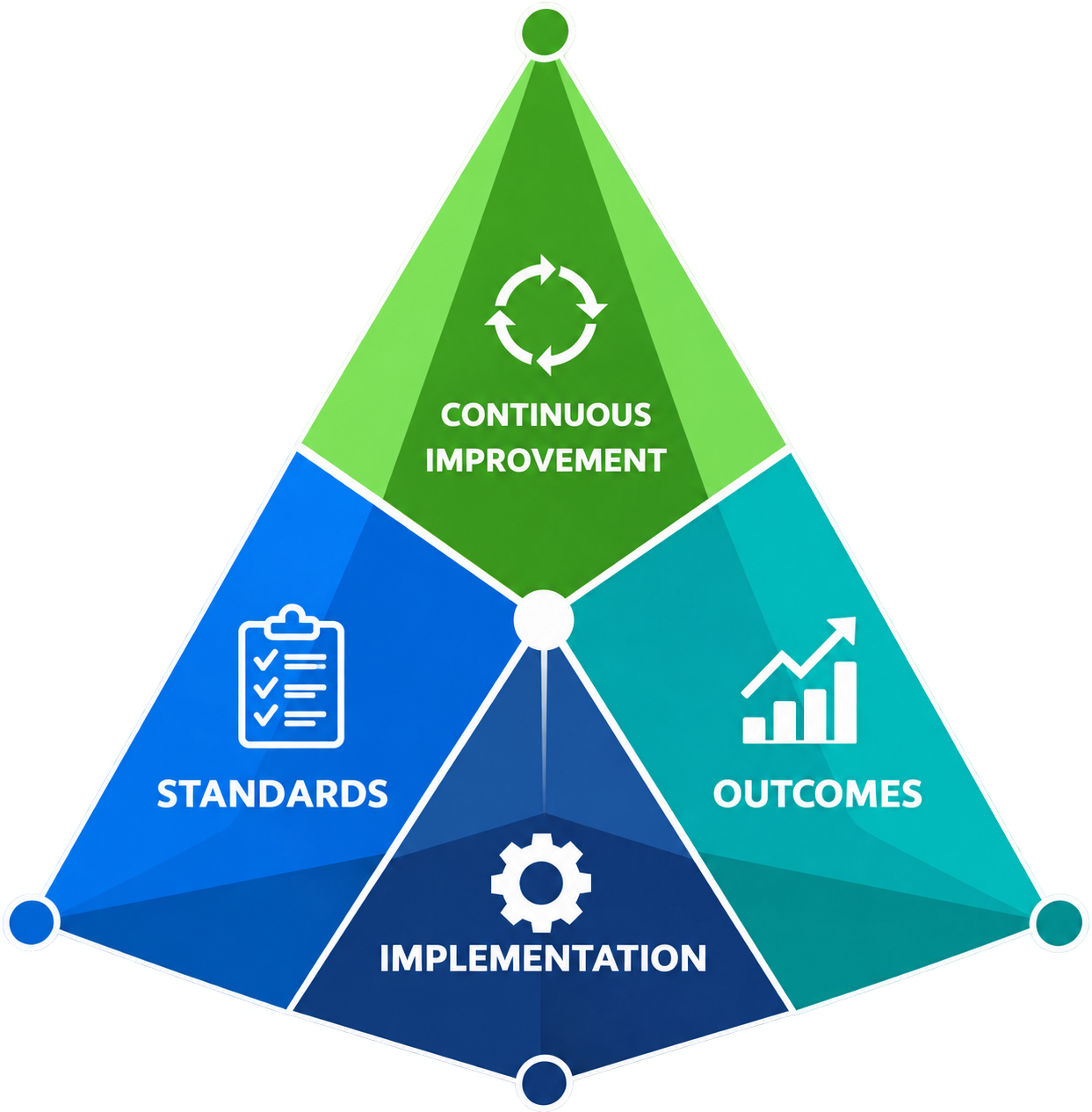
The PASQI Framework
Standards
Clear, meaningful expectations that define high-quality care.
Implementation
Evaluating how services function in practice.
Outcomes
Measuring meaningful impact for clients and families.
Continuous Improvement
Using data and feedback to strengthen systems and improve care.
Our Commitment
At its core, PASQI exists to support organizations in building systems that deliver meaningful outcomes, promote accountability, and improve the lives of the individuals and families they serve.
Our Approach
PASQI accreditation is built upon several core principles:
Practice Over Paperwork
Policies matter, but quality is demonstrated through implementation.
Patterns Over Isolated Examples
Evaluation focuses on consistent performance over time.
Meaningful Outcomes
Success is measured by the impact services have on clients and families.
Continuous Improvement
Accreditation should help organizations become stronger, not simply determine whether they pass or fail.
Better systems. Better services. Better outcomes.
PASQI's eight standards domains represent the core systems and practices that support high-quality ABA services. The standards evaluate how services function in practice, the quality of implementation, and the extent to which organizational systems lead to meaningful outcomes and continuous improvement.
Organizational Structure
High-quality services depend on strong organizational systems. This domain evaluates whether organizations maintain transparent, ethical, and well-organized administrative practices that support effective service delivery, regulatory compliance, and accountability.
Clinical Governance & Oversight
Clinical quality requires active leadership and oversight. This domain evaluates supervision, clinical decision-making, treatment integrity, and the systems organizations use to monitor and improve the quality of care.
Assessment & Treatment Planning
Meaningful intervention begins with meaningful assessment. This domain evaluates whether assessment procedures are comprehensive and whether treatment recommendations and goals are individualized, clinically relevant, and guided by objective data.
Service Delivery & Clinical Practice
Effective treatment requires more than a well-written plan. This domain evaluates how services are implemented in practice, including staff performance, client engagement, safety, coordination of care, and adherence to treatment procedures.
Treatment Effectiveness & Outcomes
The purpose of intervention is meaningful change. This domain evaluates whether treatment decisions are guided by objective data, whether progress is regularly monitored, and whether services are modified, reduced, or discontinued based on client outcomes and clinical need.
Caregiver Training & Independence
Long-term success depends on building caregiver confidence and independence. This domain evaluates whether caregiver training is individualized, measurable, and effective in helping families support and maintain treatment gains over time.
Patient Rights, Safety & Ethics
High-quality care is rooted in dignity, respect, and ethical practice. This domain evaluates how organizations protect client rights, prioritize safety, incorporate client preferences and assent, and ensure that services are delivered with integrity.
Continuous Quality Improvement
Organizations that provide high-quality care continuously evaluate and improve their systems. This domain examines how organizations use data to identify strengths and opportunities for growth, implement quality improvement initiatives, and support ongoing learning and development across all levels of the organization.
Explore Our Standards
A practical framework for evaluating and improving quality in ABA services.
PASQI Standards & Guidebook
The PASQI Standards & Guidebook provides an overview of the accreditation framework, including the eight standards domains, the purpose and rationale for each standard, examples of high-quality practice, common challenges and pitfalls, and guidance for organizations preparing for accreditation.
Version 1.0 | Published July 2026
Download the PASQI Standards & Guidebook
© 2026 Professional Accreditation Standards for Quality Intervention (PASQI). All rights reserved. No portion of this publication may be reproduced, distributed, modified, or used to create derivative accreditation systems without prior written permission from PASQI.
Leadership & Governance
PASQI's governance structure is designed to promote independence, objectivity, and accountability. Leadership responsibilities are intentionally distributed across governance, operational, and accreditation functions to support fair and consistent decision-making.
Board of Directors
Provide strategic governance and protect the long-term mission, integrity, and independence of PASQI.

PASQI Chair
Jesse Yarger, MS, BCBA, IBA
Jesse Yarger brings more than a decade of experience in applied behavior analysis, clinical leadership, organizational development, quality assurance, and professional education. He earned a Master of Science in Psychology with a concentration in Applied Behavior Analysis in Developmental Disabilities from Auburn University and is a Board Certified Behavior Analyst and licensed behavior analyst.
Throughout his career, Jesse has held clinical and executive leadership positions across autism and behavioral health organizations, with responsibilities spanning quality assurance, clinical operations, staff development, policy and procedure development, payer compliance, and organizational growth. He has founded and co-founded several organizations focused on expanding access to autism evaluation and ABA services and has consulted with ABA organizations and insurers on clinical operations, organizational development, and ABA policy.
Jesse has also taught graduate-level behavior analysis courses, developed professional training and continuing education programs, and presented nationally and internationally on clinical and professional topics. He has served the Utah Association for Behavior Analysis in numerous leadership roles, including elected board service, professional development leadership, and President-Elect.
Jesse brings to PASQI a broad perspective spanning clinical care, quality oversight, organizational leadership, payer requirements, professional education, and the development of sustainable systems for high-quality autism services.
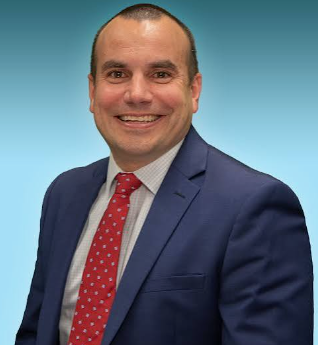
PASQI Executive Director
Paulo Guilhardi, PhD, BCBA-D
Paulo Guilhardi brings extensive experience in behavioral science, clinical services, organizational leadership, and the operations of large-scale ABA service organizations. He earned both his master’s and doctoral degrees in Experimental Psychology from Brown University, where he later held research and faculty appointments.
Paulo currently serves as Executive Vice President of Operations at Beacon ABA Services, where he oversees business operations, quality, compliance, organizational growth, and the delivery of ABA services across multiple regions. During more than a decade with Beacon, he has held progressively senior leadership positions spanning consultation, behavioral health, and operations. He also brings direct clinical experience supporting children with autism and their families across home, school, residential, and center-based settings.
In addition to his organizational leadership, Paulo has a longstanding commitment to advancing the ABA profession. He currently serves as President of the Board of Directors of the Massachusetts Association for Applied Behavior Analysis (MassABA), following prior service as President-Elect and Director at Large.
Paulo brings to PASQI a distinctive combination of scientific training, clinical expertise, executive operations experience, professional governance, and an understanding of the systems needed to deliver high-quality ABA services at scale.

PASQI Secretary
Celia Heyman, PhD, BCBA-D
Celia Heyman is a doctoral level Board Certified Behavior Analyst (BCBA-D). Her research interests include addressing interfering behaviors, Acceptance Commitment Therapy, Equivalence-Based Instruction (EBI), and Relational Frame Theory (RFT). Celia is a lead consultant at FTF Behavioral Consulting where she consults with schools and clinics on the implementation of the Practical Functional Assessment and Skill-Based Treatment. Celia is also a core faculty at Capella University’s graduate Applied Behavior Analysis program. Celia was a guest editor on the special issue covering compassion for the Behavior Analysis in Practice. Her published work includes Writing Skills for Behavior Analysts: A Practical Guide for Practitioners and Clinicians, Lifespan Treatments for Autistic Individuals, and the MOTAS-EL (Meaningful Outcomes Treatment & Assessment Scale - Early Learners.) Celia currently serves on the Development Committee of the B.F. Skinner Foundation. Pervading all her activities is a passion for disseminating more ethical, compassionate, and effective treatment based on the science of Applied Behavior Analysis. In her spare time, Celia enjoys championing and supporting aspiring behavior analysts and has culminated a Facebook community group (ABA Study Group), making up of over 60,000 members worldwide.

PASQI Vice Chair
Anika Hoybjerg, PhD, BCBA-D
Dr. Hoybjerg is the founder, owner, and CEO of Autism & Behavioral Intervention(ABI), ABA Education Center, PASQI, and Integrity Billing. Anika has also worked with children and families for over 20 years. She has a Master’s Degree in Curriculum and Instruction with an Emphasis in Autism, a Master’s Degree in Human Exceptionality, a Master's Degree in Neuroscience and Trauma, an Ed.S in School Psychology, and a Ph.D. in Applied Behavior Analysis. Anika is a Doctoral level Board Certified Behavior Analyst (BCBA-D) and a Licensed School Psychologist. Anika has presented at regional, national, and international conferences on a variety of topics relating to autism, collaboration, and assessments. Anika has done research, including her dissertation, on the importance of implementing kindness into every single interaction and treatment approach with staff, clients, and families. As a creator of the Meaningful Outcomes Treatment and Assessment Scale (MOTAS) and the Meaningful Outcomes Treatment and Assessment Scale-Early Learner (MOTAS-EL), Anika understands the importance of advocating to promote independence and higher quality of life for those individuals on the autism spectrum.

PASQI Treasurer
Dennis Heiner, MBA
Dennis Heiner brings more than three decades of experience in business, finance, education, organizational leadership, and consulting to the PASQI Board of Directors. He served for over 30 years as a professor of business at the College of Southern Idaho, where he taught accounting, economics, marketing, and business and was twice recognized as a Distinguished Professor of Merit.
Dennis holds an MBA from Texas A&M University and a bachelor's degree in marketing from Brigham Young University, with additional academic training in accounting, economics, statistics, and statistical research. Following his academic career, he served as a consultant with the Idaho Small Business Development Center, advising startups and small businesses in finance, operations, marketing, and production.
Throughout his career, Dennis has also provided consulting services to businesses, healthcare and educational organizations, and public entities, while serving in numerous community and organizational leadership roles. As Treasurer, he brings financial stewardship, business strategy, and organizational governance expertise to PASQI, supporting the organization's long-term sustainability and responsible management of its resources
Providers Seeking Accreditation
PASQI accreditation is designed to support organizations in strengthening systems, demonstrating quality, and promoting meaningful outcomes through a process of continuous quality improvement.
Why Seek Accreditation?
Demonstrate Commitment to Quality
Showcase Organizational Excellence
Build Confidence Among Client and Stakeholders
Support Continuous Improvement
Accreditation Process
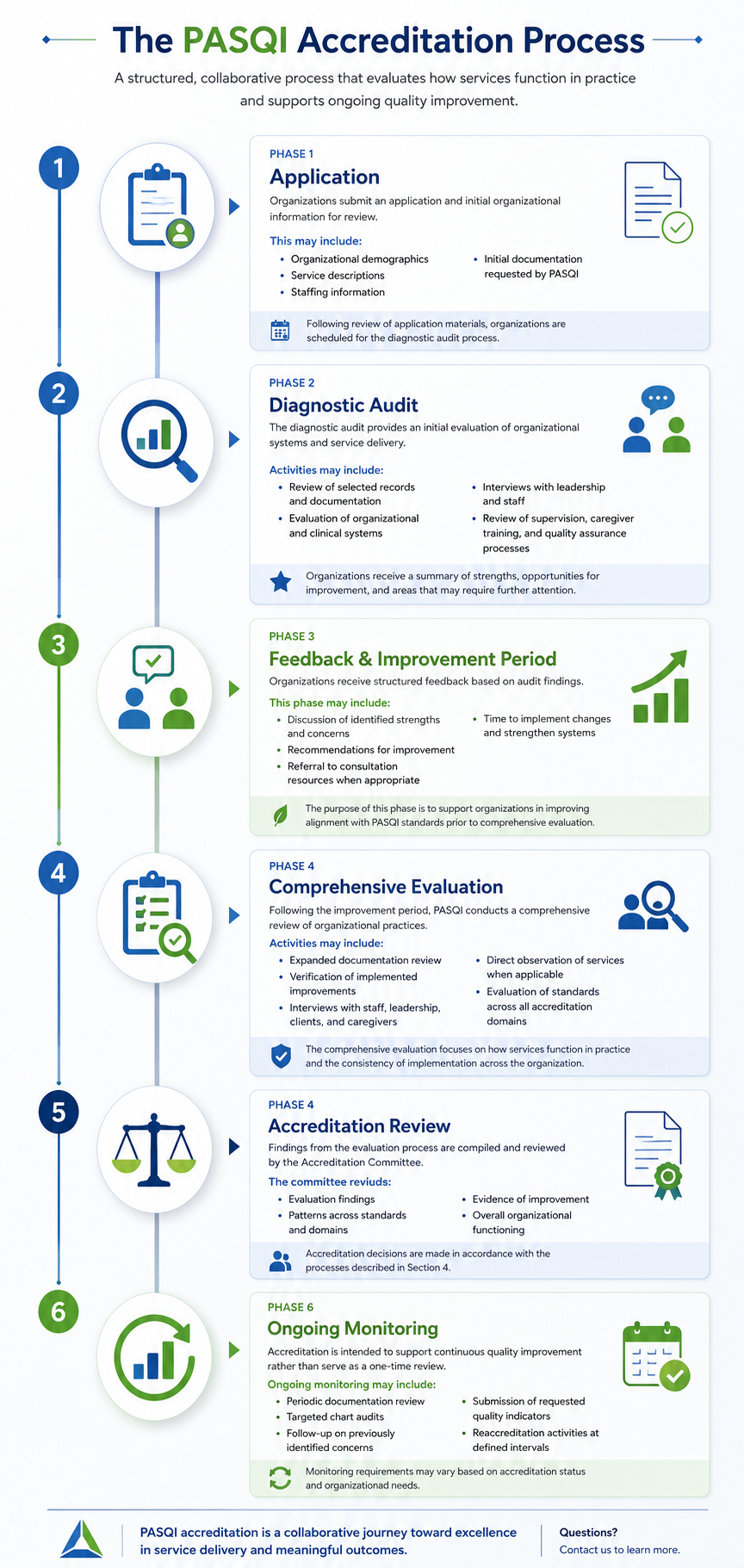
PASQI accreditation is designed to be a structured, collaborative process that evaluates how services function in practice and supports ongoing quality improvement. Although timelines may vary based on organizational size and complexity, accreditation generally occurs through six phases.
Phase 1: Application
Organizations submit an application and initial information regarding their services, staffing, and organizational structure. Following review of application materials, organizations are scheduled for the diagnostic audit process.
Phase 2: Diagnostic Audit
PASQI conducts an initial evaluation of organizational systems and service delivery through documentation review, interviews, and evaluation of key organizational processes. Organizations receive a summary of strengths and opportunities for improvement.
Phase 3: Feedback & Improvement Period
Organizations receive structured feedback and recommendations based on audit findings and are provided time to strengthen systems and implement improvements prior to comprehensive evaluation.
Phase 4: Comprehensive Evaluation
PASQI conducts a comprehensive review of organizational practices, including documentation review, interviews, verification of improvements, and evaluation of standards across all accreditation domains. The focus of this phase is understanding how services function in practice and the consistency of implementation throughout the organization.
Phase 5: Accreditation Review
De-identified findings are reviewed by the Accreditation Committee, which evaluates evidence across standards and domains and determines accreditation outcomes through an independent, multi-review process.
Phase 6: Ongoing Monitoring
Accreditation is intended to support continuous quality improvement rather than serve as a one-time review. Accredited organizations participate in ongoing monitoring activities that may include documentation review, targeted audits, quality indicator reporting, and reaccreditation activities at defined intervals.
Documentation Requirements
Organizations participating in accreditation should be prepared to provide documentation that allows PASQI to evaluate organizational systems, clinical practices, and quality improvement activities. Documentation requirements may vary based on organizational size, services provided, and accreditation scope.
Examples of requested documentation may include:
Organizational & Administrative Documentation
• Policies and procedures
• Organizational charts and role descriptions
• Licensure, certifications, and registrations
• Client handbooks and onboarding materials
• Complaint and grievance procedures
• Administrative and leadership records
Human Resources & Training Documentation
• Staff files and onboarding records
• Credentialing records
• Competency assessments
• Supervision and fieldwork documentation
• Performance feedback and corrective action records
Clinical Documentation
• Assessment reports and behavior intervention plans
• Treatment plans and clinical recommendations
• Session notes and service delivery records
• Data collection and outcome monitoring systems
• Discharge planning and treatment modification records
Quality & Compliance Documentation
• Quality assurance and improvement activities
• Incident reporting and safety documentation
• Compliance monitoring and audit records
• Organizational dashboards and performance reports
• Documentation of system-wide changes and improvement initiatives
Additional Information
PASQI may also request interviews, direct observations, and additional documentation as needed to evaluate organizational systems and service delivery practices.
Accreditation Timeline & Fees
Since these aren't finalized, keep it simple.
Accreditation Timeline
Timelines may vary based on organizational size, complexity, and readiness. Additional information regarding anticipated timelines will be available prior to the launch of accreditation services.
Accreditation Fees
PASQI is committed to developing a fair and transparent fee structure that supports organizations of varying sizes and service models. Fee schedules will be published prior to the launch of accreditation services.
Frequently Asked Questions
-
PASQI accreditation is available to organizations that provide Applied Behavior Analysis (ABA) services and are committed to quality improvement, ethical practice, and meaningful outcomes. Eligible organizations may include providers of comprehensive ABA services, focused intervention, caregiver training, consultation, and other ABA service models.
Organizations seeking accreditation should have established systems for clinical oversight, service delivery, and quality assurance and be willing to participate in a collaborative process of evaluation and continuous improvement.
-
At this time, PASQI accreditation is voluntary unless otherwise required by a state agency, payer, or contractual agreement. Organizations may choose to pursue accreditation to demonstrate their commitment to quality, accountability, and continuous improvement in ABA services.
Accreditation requirements may vary by state, payer, or regulatory environment, and organizations should consult applicable requirements within their jurisdiction.
-
Accreditation timelines vary based on organizational size, complexity, readiness, and the amount of time needed to implement improvements identified during the review process. Because PASQI's accreditation model incorporates a diagnostic audit and improvement period, the process is designed to be flexible and collaborative rather than constrained to a fixed timeline.
Additional information regarding anticipated timelines will be published prior to the launch of accreditation services.
-
Documentation requirements vary based on organizational size, services provided, and the scope of accreditation. In general, organizations should be prepared to provide information that allows PASQI to evaluate organizational systems, clinical practices, and quality improvement activities.
Examples of requested documentation may include policies and procedures, organizational and staffing information, staff credentialing and training records, assessment and treatment documentation, quality assurance activities, and sample clinical records. PASQI may also request interviews, direct observations, and additional documentation as needed to evaluate how services function in practice.
-
Accreditation decisions are made by the PASQI Accreditation Committee through an independent, multi-review process. Committee members review de-identified findings and evidence gathered during the accreditation process and evaluate patterns across standards and domains.
To promote objectivity and reduce the potential for bias, accreditation decisions require agreement among multiple committee members, and individuals with conflicts of interest may not participate in the review process. Surveyors collect evidence but do not participate in accreditation decisions.
Additional Questions
-
PASQI recognizes that quality improvement is an ongoing process and that organizations vary in their strengths and areas for growth. Accreditation decisions consider patterns of performance, implementation, and evidence of organizational improvement rather than isolated findings.
When concerns are identified, organizations may receive feedback, recommendations, corrective actions, or opportunities to strengthen systems and demonstrate improvement. The goal of the accreditation process is to support meaningful quality improvement while maintaining clear expectations for high-quality care.
-
Yes. PASQI provides structured feedback and recommendations to help organizations identify strengths, address areas of concern, and strengthen systems that support high-quality care. The accreditation process is designed to promote continuous quality improvement and organizational learning.
To maintain the independence and integrity of the accreditation process, PASQI does not implement improvements on behalf of organizations. When appropriate, organizations may be referred to external consultation resources.
-
Reaccreditation occurs at defined intervals established by PASQI and may vary based on accreditation status, organizational performance, and ongoing monitoring activities. The reaccreditation process is intended to support continuous quality improvement and ensure that organizations continue to demonstrate high-quality, ethical, and effective service delivery.
-
PASQI is committed to developing a fair and transparent fee structure that supports organizations of varying sizes and service models. Accreditation fees will consider factors such as organizational size, complexity, and the scope of accreditation activities.
Detailed information regarding accreditation fees and fee schedules will be published prior to the launch of accreditation services.
-
PASQI is committed to fairness, transparency, and due process. Organizations that disagree with an accreditation decision may request reconsideration or appeal in accordance with PASQI's policies and procedures.
The appeal process is designed to ensure that accreditation decisions are applied consistently and that organizations have an opportunity to raise concerns regarding the evaluation process or accreditation findings.
Interested in learning more about PASQI accreditation? We welcome the opportunity to speak with organizations about the accreditation process, answer questions, and provide updates regarding timelines, fees, and future accreditation opportunities.
Funders & State Agencies
PASQI provides an independent, ABA-specific framework for evaluating organizational quality, implementation, and outcomes to support accountability, transparency, and continuous quality improvement in service delivery.
Why ABA-Specific Accreditation?
Applied Behavior Analysis is a specialized field with unique clinical, ethical, and operational considerations. PASQI was developed specifically to evaluate the systems and practices that support high-quality ABA services and to provide an accreditation framework informed by expertise in behavior analysis, healthcare quality, and organizational performance.
Our standards and processes are designed to evaluate not only whether policies exist, but how services function in practice and whether organizational systems support meaningful outcomes for individuals and families.
How PASQI Supports Funders & State Agencies
-
PASQI provides an independent accreditation framework designed specifically for Applied Behavior Analysis organizations. Unlike general healthcare accreditation models, PASQI's standards evaluate the systems, implementation, and outcomes that are unique to high-quality ABA service delivery.
PASQI operates independently and is not affiliated with provider trade organizations, advocacy groups, or payer entities. This independence helps ensure that accreditation standards and decisions remain objective, impartial, and focused on quality improvement and meaningful outcomes.
-
PASQI evaluates both the implementation of organizational systems and the outcomes they are intended to produce. In addition to reviewing policies and documentation, PASQI examines how services function in practice, the consistency of implementation, and whether organizational systems support meaningful outcomes for individuals, families, and providers.
-
PASQI's accreditation model is designed to support long-term organizational growth, not simply evaluate compliance at a single point in time. Through structured feedback, ongoing monitoring, and an emphasis on continuous quality improvement, PASQI encourages organizations to strengthen systems, improve implementation, and build sustainable practices that support high-quality care.
-
PASQI utilizes standardized evaluation tools, structured review procedures, and ongoing reliability activities to promote consistency and objectivity throughout the accreditation process. Surveyors receive extensive training and participate in ongoing calibration and interobserver agreement (IOA) activities, and accreditation decisions are made through an independent, multi-review process designed to reduce bias and support reliable outcomes.
-
PASQI incorporates multiple safeguards to promote reliability, objectivity, and fairness throughout the accreditation process. These safeguards include standardized surveyor training, ongoing calibration and interobserver agreement (IOA) activities, conflict-of-interest protections, de-identified committee review, and accreditation decisions that require agreement among multiple committee members rather than the judgment of any single individual.
-
PASQI encourages transparency and continuous quality improvement by helping organizations identify strengths, monitor performance, and address opportunities for growth. Through structured feedback, ongoing monitoring, and an emphasis on meaningful outcomes, PASQI supports provider organizations in building systems that promote accountability, learning, and sustained improvement over time.
Collaboration Opportunities
PASQI welcomes opportunities to collaborate with state agencies, health plans, professional organizations, and other stakeholders interested in advancing quality, accountability, and meaningful outcomes in ABA services.
-
PASQI welcomes opportunities to collaborate on quality initiatives and pilot programs designed to advance accountability, improve service delivery, and evaluate innovative approaches to quality measurement in ABA services. Potential collaborations may include accreditation pilots, quality improvement initiatives, implementation studies, and efforts to better understand the relationship between organizational practices and meaningful outcomes.
-
PASQI welcomes opportunities to collaborate on the recognition and implementation of ABA-specific accreditation requirements. Potential areas of collaboration include the development of accreditation pathways, implementation strategies, pilot initiatives, and approaches to integrating accreditation into quality improvement and provider oversight efforts.
-
PASQI welcomes opportunities to collaborate on research and outcomes initiatives that advance the understanding of quality, organizational performance, and meaningful outcomes in ABA services. Potential collaborations may include validation studies, quality indicator development, implementation research, accreditation effectiveness studies, and initiatives designed to strengthen the evidence base for high-quality care.
-
PASQI welcomes opportunities to collaborate on the development and evaluation of quality indicators and performance measures that support accountability, continuous quality improvement, and meaningful outcomes in ABA services. These efforts may include identifying meaningful measures of organizational performance, treatment effectiveness, implementation quality, and other indicators that can inform quality improvement initiatives and policy decisions.
-
PASQI welcomes opportunities to provide consultation regarding ABA-specific quality standards and the unique clinical, ethical, and operational considerations of ABA service delivery. Consultation activities may include discussions related to quality frameworks, accreditation initiatives, implementation strategies, and approaches to promoting accountability and meaningful outcomes in ABA services.
Additional Information
Interested in learning more about PASQI or exploring opportunities for collaboration? We welcome conversations with funders, state agencies, and other stakeholders committed to advancing quality, accountability, and meaningful outcomes in ABA services.
Get Involved
Become a Surveyor
PASQI welcomes individuals interested in supporting quality improvement through objective evaluation and accreditation activities. Opportunities for surveyor training and recruitment will be announced as accreditation services expand.
Join an Advisory Group
PASQI values the expertise of clinicians, researchers, educators, and advocates committed to advancing quality in ABA services.
Partnership Opportunities
Explore opportunities to collaborate on quality initiatives, pilot programs, research, and accreditation implementation efforts.
Research & Innovation
Support the advancement of accreditation science, quality measurement, and meaningful outcomes in ABA services.
Stay Connected
Receive updates regarding accreditation activities, new resources, and opportunities to collaborate with PASQI.
Contact PASQI
Privacy Notice
Information submitted through this form will be used solely for communication regarding PASQI activities and will not be sold or shared with third parties.